Essays · Knowledge, Learning & Expertise
The Half-Life of Professional Knowledge
Why expertise expires faster than ever — and what to do about it
⇩ Download PDF Free, Lateral House edition
How this was made. This essay was AI-drafted. The author directed it, shaping the argument, structure, sourcing and edits, rather than writing each sentence personally.
Contents
- Not All Knowledge Ages the Same Way
- Renewal Capacity
- The Knowledge Portfolio
- Why Experienced Professionals Often Feel Change More Acutely
- Every Profession Has a Knowledge Half-Life Profile
- What Is Accelerating the Half-Life of Professional Knowledge?
- Managing the Knowledge Portfolio
- The Shadow Side of the Framework
- Conclusion
- Map Your Knowledge Portfolio
- Notes and Sources
There comes a moment in almost every professional career that is difficult to describe yet impossible to forget.
Nothing dramatic happens. There is no public failure, no sudden loss of competence, no single event that announces a turning point. Instead, the realization arrives quietly. A familiar task takes longer than it once did. A younger colleague solves a problem using methods that feel unfamiliar yet surprisingly effective. A regulation changes. A software update transforms a workflow that had become second nature. A client raises a question that simply would not have existed a decade earlier.
What makes these moments unsettling is not that years of learning have suddenly become incorrect. They have not. The professional remains capable, experienced, and knowledgeable. What has changed is the environment in which that knowledge is expected to operate. The knowledge itself is still valid; its fit with the surrounding world has diminished.
Most experienced professionals recognize this feeling. Few pause to examine what it represents.
The Half-Life of Professional Knowledge is the characteristic period over which a meaningful portion of a professional's usable knowledge loses contextual relevance because the environment in which it was acquired has changed.
Knowledge does not simply disappear, nor does experience become worthless with time. Rather, different forms of knowledge lose practical relevance at different rates because the contexts in which they are applied evolve differently. The useful life of knowledge is therefore shaped not only by its intrinsic quality but by the stability, or instability, of the environment surrounding it.
This framework is not intended to measure professionals or rank expertise. Its purpose is more modest, and perhaps more useful: to provide a clearer way of thinking about how professional relevance changes over time, and how individuals and organizations might respond more intelligently to that change.
At first glance this may appear to be another way of saying that the world changes. It is not.
The world has always changed. Professions have always evolved. New technologies have replaced old ones, scientific understanding has advanced, laws have been rewritten, and markets have continually adapted. Change itself is neither new nor remarkable.
What is different today is that different forms of professional knowledge are changing at markedly different rates. Some become obsolete almost overnight when technologies, software platforms, or organizational processes shift. Others remain useful for decades despite dramatic external change. Still others, particularly those rooted in judgment, interpretation, and human understanding, often increase in value precisely because the surrounding environment has become more complex.
Existing discussions of lifelong learning, upskilling, reskilling, continuing professional development, and the future of work all begin from the same observation: professionals must keep learning throughout their careers. Yet these conversations generally treat professional knowledge as a single, undifferentiated entity — an assumption that obscures an important reality.
Professional knowledge is not homogeneous. Different forms of knowledge exhibit different degrees of context dependency — the extent to which their usefulness depends on the continued stability of the environment in which they are applied. As contexts evolve, these differences produce distinctive patterns of renewal across professions and across individual careers.
From this observation emerge two complementary concepts.
The Knowledge Half-Life Profile describes the characteristic pattern through which different forms of knowledge retain or lose relevance within a particular profession. Banking, medicine, constitutional law, engineering, and software development each have distinct profiles, because the balance of operational knowledge, conceptual understanding, and professional judgment differs substantially across them.
The Knowledge Portfolio represents the unique combination of knowledge assets held by an individual professional. Every career reflects a different distribution of operational skills, conceptual understanding, and judgment developed through experience. Two professionals with identical qualifications and years of experience may therefore hold fundamentally different portfolios — and, consequently, very different capacities to remain relevant as their environments evolve.
The objective is not to maximize the life of knowledge. It is to maximize the relevance of knowledge.
Together, these ideas offer a different lens through which professional development can be understood. Rather than asking only how much a professional knows, the framework encourages a more meaningful question: how well does that knowledge continue to fit the world in which it is expected to create value?
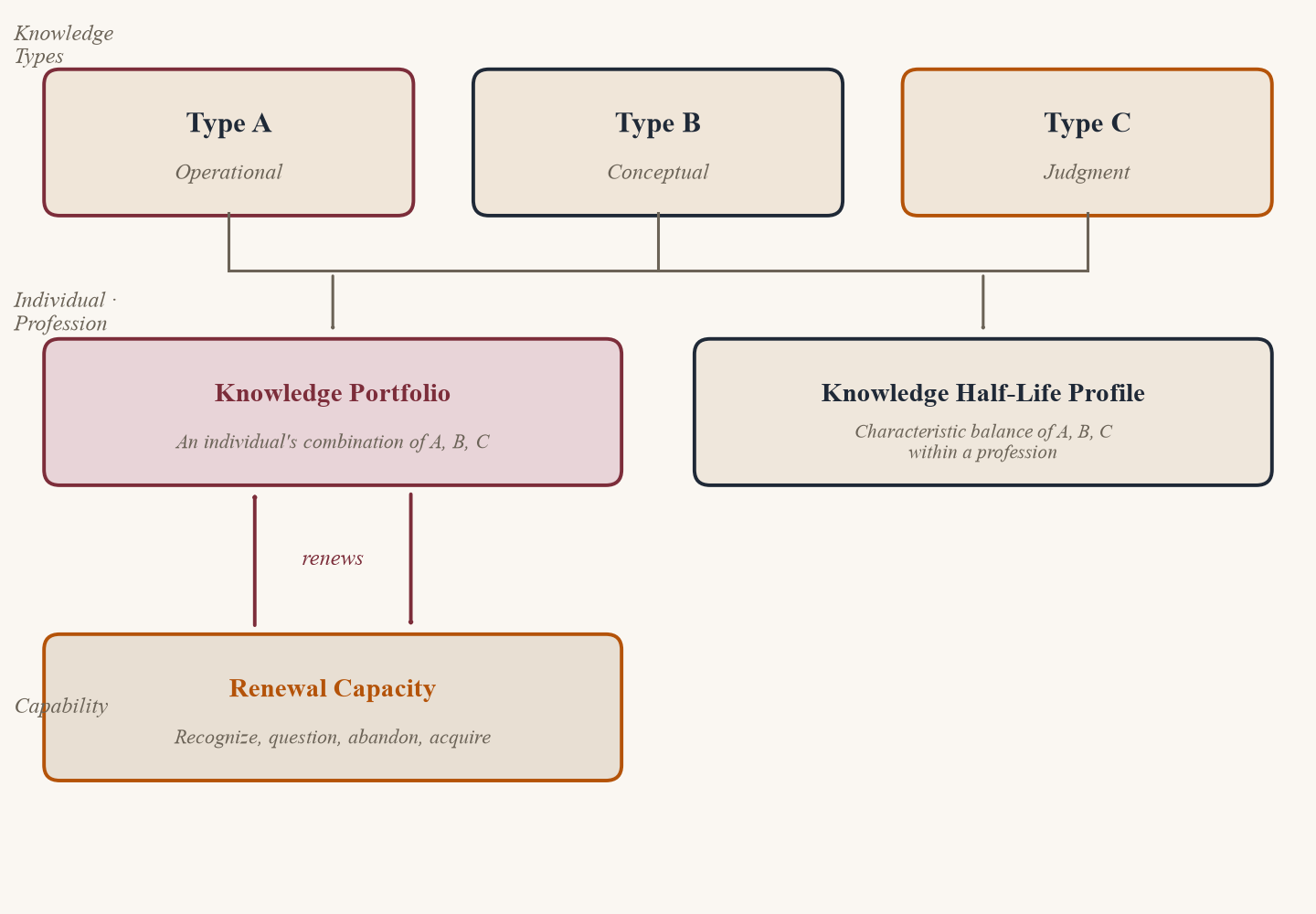
Not All Knowledge Ages the Same Way
If professional knowledge loses relevance over time, an obvious question follows: why do some forms of knowledge become obsolete quickly while others remain valuable for decades?
The answer lies in a property this article calls context dependency — the extent to which the usefulness of a body of knowledge relies on the continued stability of the environment in which it is applied. Every form of professional knowledge depends on context to some degree. The distinction is not whether knowledge is context-dependent, but how strongly it depends on context, and how rapidly that context changes.
Knowledge tightly coupled to a specific technology, organizational process, regulatory framework, or operating environment will generally require more frequent renewal than knowledge grounded in enduring principles or human judgment. Seen this way, professional expertise is not a single body of knowledge but a collection of knowledge types, each with its own pattern of renewal.
Type A: Operational Knowledge
Type A knowledge enables professionals to perform work within a specific operating environment. It answers questions such as: How do I complete this task? Which procedure should I follow? Which interface should I use? Which sequence of actions produces the desired outcome?
Examples include software interfaces, product features, workflow procedures, machine operation, coding syntax, platform navigation, reporting formats, and organization-specific processes.
Operational knowledge is indispensable because it translates intention into execution. It is also the most vulnerable to contextual change. A bank employee may spend years mastering a core banking platform, only to encounter a completely redesigned system after a technology migration. An engineer may become highly efficient with a particular CAD application before the organization adopts an entirely different suite. A physician may learn an electronic medical record system that is later replaced by another vendor.
In each case, the professional has not become less capable. The environment supporting that capability has changed.
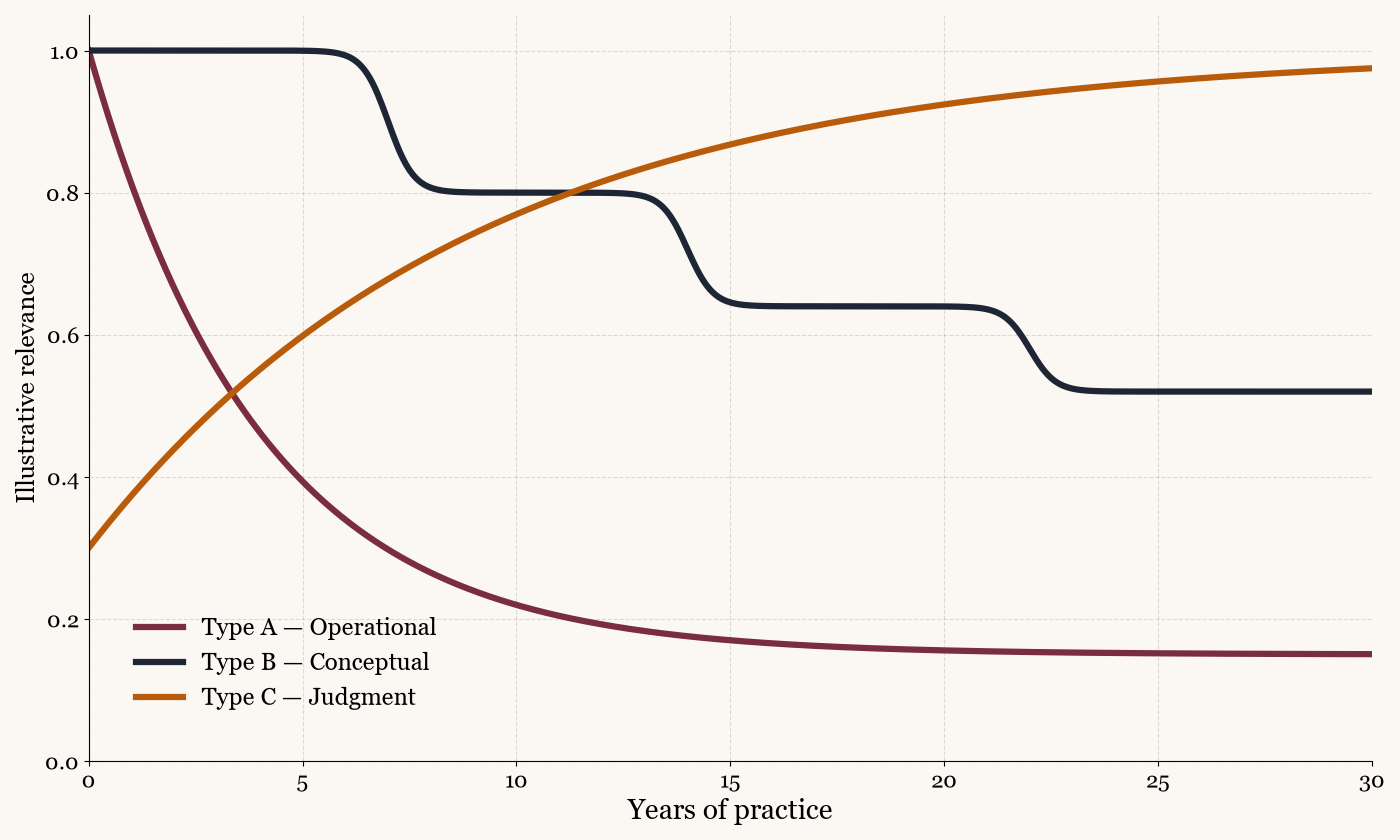
Type A knowledge therefore exhibits high context dependency. Its relevance is often compressed by technological innovation, platform replacement, organizational redesign, or procedural revision. Renewal tends to occur through short learning cycles, practical experience, and repeated adaptation to evolving tools.
Type B: Conceptual Knowledge
Where Type A knowledge governs execution, Type B knowledge governs understanding. It answers questions such as: What principles organize this discipline? Which conceptual framework explains this situation? Which standards or regulations govern this decision?
Examples include accounting standards, legal doctrines, engineering codes, financial regulations, diagnostic criteria, scientific theories, and professional models.
Unlike operational knowledge, conceptual knowledge is relatively insulated from frequent technological change. Instead, it evolves in discrete episodes when the conceptual architecture of a profession itself changes: a new accounting standard alters financial reporting, a landmark judicial decision reshapes legal interpretation, a revised clinical guideline changes accepted medical practice, an updated regulatory framework redraws compliance expectations.
Between such events, conceptual knowledge often remains remarkably stable. When change does occur, however, it can be rapid and far-reaching, because the underlying framework itself has shifted. Type B knowledge therefore demonstrates moderate context dependency, and its renewal follows the evolution of governing principles rather than the replacement of operational tools.
Type C: Judgment Knowledge
Some of the most valuable professional capabilities cannot be found in manuals, regulations, or software documentation. They emerge through experience.
Type C knowledge is professional judgment — the ability to interpret incomplete information, recognize patterns, navigate ambiguity, and decide where no procedure offers a complete answer. It addresses questions such as: What is actually happening here? Which factors matter most? Which option is appropriate under these particular circumstances?
A surgeon senses that something is wrong before the monitors reveal it. A relationship manager detects hesitation in a client's otherwise confident proposal. An experienced auditor notices inconsistencies that no checklist explicitly identifies. A senior project leader recognizes organizational resistance long before it appears in performance indicators.
These capabilities arise not simply from accumulated experience, but from deliberate reflection upon experience. Type C knowledge exhibits relatively low context dependency because it is grounded in human behavior, reasoning, and pattern recognition rather than specific technologies or procedures. Although it continues to evolve throughout a career, it generally retains relevance across changing tools, organizations, and regulatory environments — and increasing complexity often increases, rather than diminishes, its value.
Renewal Capacity
Beneath these three knowledge types lies something fundamentally different — not another category of professional knowledge, but the capability that determines whether the other three remain relevant. This article calls that capability Renewal Capacity.
Renewal Capacity is the ability to recognize when existing knowledge is losing contextual fit, to deliberately question long-held assumptions, to abandon practices that no longer serve their purpose, and to acquire new knowledge before obsolescence becomes consequential.
Professionals with strong Renewal Capacity rarely avoid change. Instead, they adapt to it more effectively, because they treat knowledge itself as dynamic. Renewal Capacity turns learning from a reactive response into an ongoing professional discipline.
It should not be confused with constant learning for its own sake. The objective is not to maximize the lifespan of knowledge; it is to maximize its relevance. A professional who continually acquires new information without understanding its relevance simply accumulates knowledge. A professional who consciously renews knowledge in response to changing contexts maintains relevance. This distinction sits at the philosophical center of the framework, and it governs the long-term resilience of every Knowledge Portfolio discussed below.
The Knowledge Portfolio
If professional knowledge is not a single, uniform body of expertise, then careers cannot be understood simply as the accumulation of experience. They are better understood as the gradual construction of a Knowledge Portfolio: the unique combination of knowledge assets an individual develops over a career.
Like an investment portfolio, it contains assets with different characteristics. Some provide immediate operational value but require frequent renewal. Others appreciate slowly through reflection and experience. Some are highly exposed to changes in technology or regulation; others hold their value across multiple organizational and technological eras.
The analogy should not be taken too far — the framework does not seek to financialize professional development. It simply offers a practical way of thinking about how different forms of knowledge coexist, interact, and require different patterns of maintenance.
Every professional, consciously or not, decides where to invest limited learning time. Some devote most of their effort to mastering the latest tools, platforms, and procedures. Others invest heavily in conceptual understanding, theory, or regulatory expertise. Still others consciously cultivate judgment through varied experience, reflection, mentoring, and increasingly complex assignments. These choices shape resilience.
Consider two engineers, each with twenty-five years of experience. On paper, their careers look almost identical: similar qualifications, comparable positions, projects of similar scale. Yet their Knowledge Portfolios may be fundamentally different.
The first engineer has invested predominantly in operational knowledge, becoming exceptionally proficient with specific software platforms, proprietary workflows, and organization-specific procedures. They perform today's work with remarkable efficiency — but much of that expertise depends on technologies and organizational structures that may eventually change.
The second engineer has developed operational competence too, but alongside it has built conceptual knowledge of the engineering principles that transcend any one software package, and — through years of varied projects — judgment: the ability to recognize patterns, anticipate failure, communicate uncertainty, and adapt solutions to unfamiliar situations.
Both professionals possess experience. Only one possesses a diversified Knowledge Portfolio. The distinction is invisible on a résumé. It becomes visible when circumstances change.
The portfolio perspective turns an abstract worry — Am I keeping up? — into practical questions any professional can periodically ask: What does my Knowledge Portfolio look like today? Which parts of my expertise are highly context-dependent? Which capabilities are likely to hold value even if my environment changes? Where have I neglected renewal, and where am I overinvested? These questions replace anxiety about keeping pace with everything with conscious stewardship of one's own expertise.
Why Experienced Professionals Often Feel Change More Acutely
The framework also explains an apparent paradox. Beginners know relatively little, yet they often adapt to change with remarkable ease. Experienced professionals possess vastly greater expertise, yet they frequently describe periods of technological or organizational transformation as deeply unsettling.
The explanation lies not in intelligence or willingness to learn, but in portfolio size. A new entrant arrives with few established knowledge assets; almost everything they learn reflects the current environment. Their operational knowledge aligns naturally with contemporary technologies, and their conceptual knowledge reflects current standards — there is little historical investment to adjust.
Experienced professionals face a different challenge. Over years, or decades, they accumulate substantial portfolios built under earlier technological, regulatory, and organizational conditions. Much of that knowledge remains valuable; some of it has quietly become misaligned with the present environment.
The experienced professional is not struggling because they know less. They are struggling because they know more — and because a larger share of what they know now requires conscious evaluation, renewal, or rebalancing.
This reframing matters. Too often, organizations read such moments as evidence that experienced professionals have become obsolete. The framework suggests the opposite reading: the discomfort many experienced professionals feel is not a signal of declining capability. It is an early-warning signal that parts of their Knowledge Portfolio need rebalancing — which makes adaptation an act of stewardship rather than replacement.
Every Profession Has a Knowledge Half-Life Profile
Individuals possess Knowledge Portfolios. Professions possess Knowledge Half-Life Profiles — the characteristic balance of operational, conceptual, and judgment knowledge required for effective practice. Because professions differ in the composition of these knowledge types, they also differ in how rapidly expertise must be renewed.
This does not simply mean that one profession changes faster than another. It means that different forms of change interact differently with different forms of knowledge.
Few professions illustrate the framework more clearly than banking. Modern banking combines nearly every major source of professional change at once. Technology continuously reshapes customer interaction, payment systems, fraud detection, cybersecurity, and internal operations. Regulation evolves in response to financial innovation, geopolitical developments, consumer protection priorities, and systemic risk. Organizational restructuring accompanies digital transformation, while customer expectations keep shifting toward faster, more personalized, more digital experiences.
As a result, banking carries substantial Type A knowledge. A retail banker who mastered branch-based cash operations, manual reconciliation, or legacy banking software may later find entire workflows gone after a core-banking modernization. A compliance professional who thoroughly understood one regulatory framework may need to reinterpret that expertise after new prudential requirements, data-privacy legislation, anti-money-laundering standards, or open-banking regulation. In each case the knowledge itself has not become wrong — the context in which it created value has changed.
Yet within the same profession, other capabilities show remarkable continuity. An experienced relationship manager's ability to read client motivations, spot emerging credit concerns before they surface in formal metrics, or navigate a difficult commercial negotiation, usually remains valuable regardless of technological change. These belong largely to Type C — and often become more valuable precisely because technology automates the routine work around them.
Banking is therefore a particularly revealing laboratory for the framework: rapid renewal of operational knowledge, periodic renewal of conceptual knowledge, and a growing reliance on judgment.
Other professions show markedly different profiles. Medicine carries substantial conceptual knowledge, as clinical evidence, diagnostic criteria, and treatment guidelines evolve through research — yet a physician's ability to synthesize incomplete information, communicate uncertainty with empathy, and exercise clinical judgment stays comparatively stable across decades of practice. Constitutional law presents yet another profile: judicial interpretation evolves and precedent accumulates, but careful reasoning, textual analysis, and structured argument remain enduring capabilities that carry across generations.
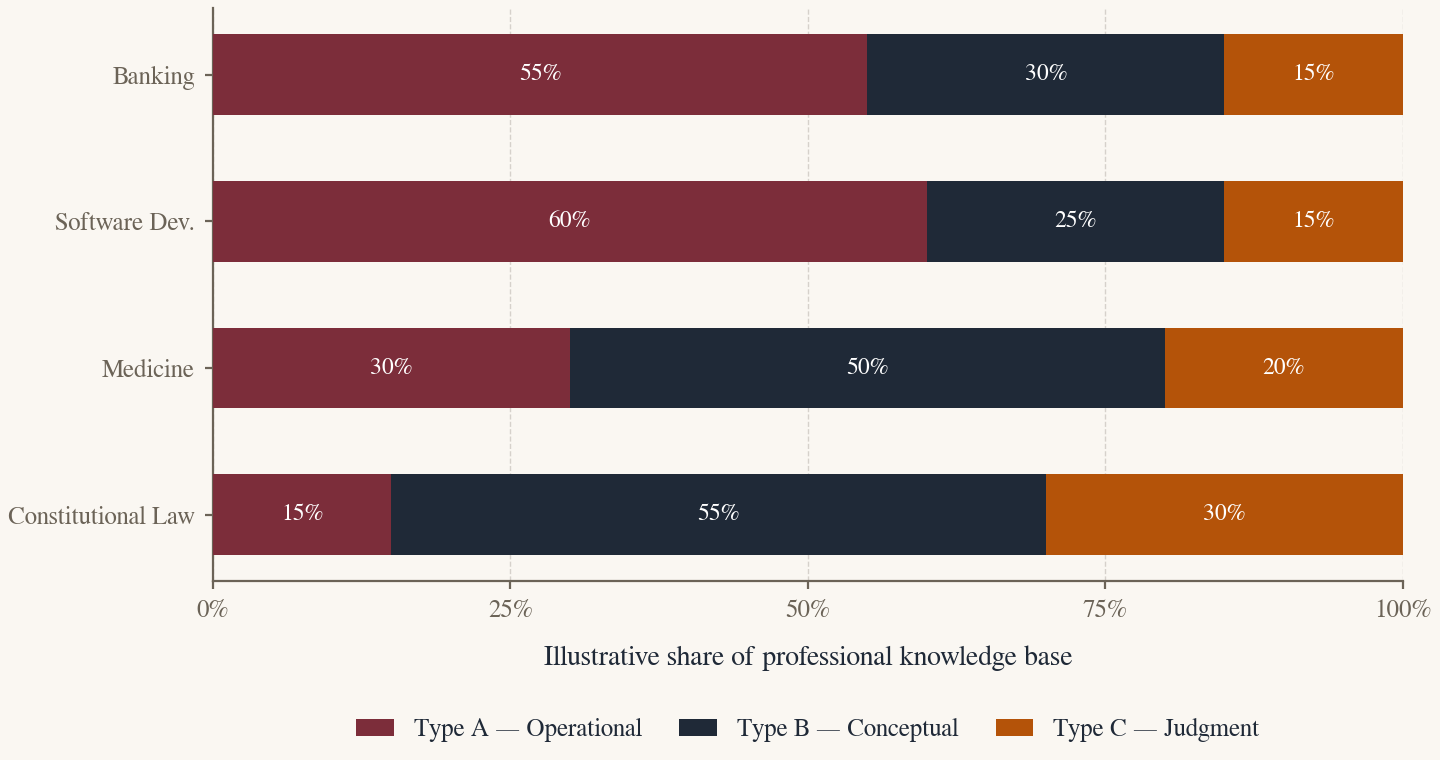
The Half-Life of Professional Knowledge is not a single number. It is a profile — and understanding that profile lets individuals and organizations make more deliberate decisions about learning, renewal, and the long-term development of professional capability.
What Is Accelerating the Half-Life of Professional Knowledge?
Professional knowledge has never been permanent. Every generation has lived through changes in technology, institutions, science, and professional practice. This framework does not claim that knowledge has suddenly become perishable. It argues that several contemporary forces are compressing the useful life of context-dependent knowledge, and increasing how often professionals must renew their portfolios. These forces rarely act alone — they interact, reinforce one another, and often arrive together.
Technological Acceleration — Technology is the most visible driver of context dependency. Every major technological transition reshapes the operating environment: software platforms evolve, automation replaces manual processes, digital interfaces alter customer interaction, and new tools redefine what counts as efficient practice. For professionals whose expertise sits mostly in Type A knowledge, technological change can compress the useful life of that expertise dramatically. In software development, programming languages endure, but frameworks, deployment architectures, cloud platforms, and security practices evolve continuously. A developer who stops learning rarely becomes technically wrong; the surrounding ecosystem simply moves beyond the environment in which the expertise was formed. The same pattern shows up across engineering, healthcare, education, manufacturing, and financial services. Technology does not merely add new knowledge — it reshapes the context in which existing knowledge has to operate.
Artificial Intelligence and the Economics of Knowledge — Artificial intelligence is a distinctive accelerator because it changes not only professional tools, but the economics of professional knowledge itself. For most of modern professional history, possessing information created value: professionals were rewarded for remembering regulations, diagnostic criteria, technical procedures, precedents, formulas, or organizational knowledge that others lacked. AI changes this relationship. Information becomes abundant, retrieval becomes instant, and routine operational knowledge becomes easier to access. Professional value shifts, correspondingly, from possessing information toward higher-order capability: asking better questions, weighing competing sources, spotting contextual nuance, exercising judgment under uncertainty, integrating diverse perspectives, and deciding when an automated recommendation should — or should not — be trusted. AI may reduce the scarcity of some Operational Knowledge while increasing the importance of Judgment Knowledge. The challenge for professionals is not to out-remember artificial intelligence — it is to work alongside intelligent systems while strengthening the human capabilities that remain comparatively resistant to automation.
Regulatory Evolution — Many professions now operate inside increasingly dynamic regulatory environments. Finance, healthcare, law, aviation, pharmaceuticals, environmental management, and cybersecurity all show the same pattern: regulation is revised, expanded, and reinterpreted continuously in response to innovation, emerging risk, and shifting expectations, rather than slowly over decades. Conceptual knowledge therefore needs more frequent renewal than it once did. Professionals rarely start from zero — existing frameworks remain valuable — but they must be continually reinterpreted within a changing regulatory context. The challenge is adaptation, not replacement.
Organizational Change — Organizational change is perhaps the least discussed, yet one of the most powerful, sources of context dependency. Knowledge often loses relevance not because technology changes or regulation evolves, but because an organization redesigns how work itself gets done. A restructuring changes reporting lines. A platform migration alters workflows. An acquisition combines different organizational cultures. Remote work reshapes communication. Cross-functional teams replace hierarchical departments. What it took to succeed in yesterday's organization may not transfer cleanly into tomorrow's. Professionals often read this as personal inadequacy; more often it is simply contextual misalignment — and recognizing the difference reduces unnecessary anxiety while encouraging deliberate renewal.
Information Saturation — Modern professionals work inside an unprecedented abundance of information. Research publications, technical documentation, online courses, regulatory updates, podcasts, webinars, newsletters, social media, and increasingly sophisticated AI systems generate knowledge faster than any individual can absorb. The consequence is not simple overload but a widening gap between what professionals know and what they feel they ought to know — a persistent sense of falling behind even among highly competent people. The more constructive framing is that the objective was never comprehensive knowledge; that goal is no longer realistic. The objective is a Knowledge Portfolio that stays relevant to one's professional context. The challenge is alignment, not accumulation.
Managing the Knowledge Portfolio
Viewing professional development through the lens of a Knowledge Portfolio changes the nature of career management. Instead of asking How can I learn everything?, professionals begin asking Which parts of my portfolio need attention? The difference is subtle but significant: the objective is not endless learning, but purposeful renewal.
Certain signals reliably indicate a portfolio needs rebalancing: a familiar task starts generating unexpected friction; colleagues adopt unfamiliar approaches that are demonstrably effective; professional conversations increasingly reference concepts that feel new or distant; long-established practices need repeated justification rather than naturally fitting the moment. None of this is evidence of declining competence — it is feedback. Like a financial portfolio drifting from its intended allocation, a Knowledge Portfolio needs periodic rebalancing.
Different knowledge types call for different renewal strategies. Operational knowledge responds well to practical simulation, short-cycle training, experimentation, and hands-on exposure to new tools. Conceptual knowledge benefits from engagement with evolving standards, professional communities, draft regulation, and continuing scholarship. Judgment knowledge develops differently — through reflective practice, mentoring, difficult experiences, structured feedback, and deliberate engagement with complexity rather than routine.
Renewal Capacity itself develops through habits of intellectual humility: questioning assumptions, seeking unfamiliar perspectives, staying curious despite expertise, and becoming comfortable replacing methods that no longer fit.
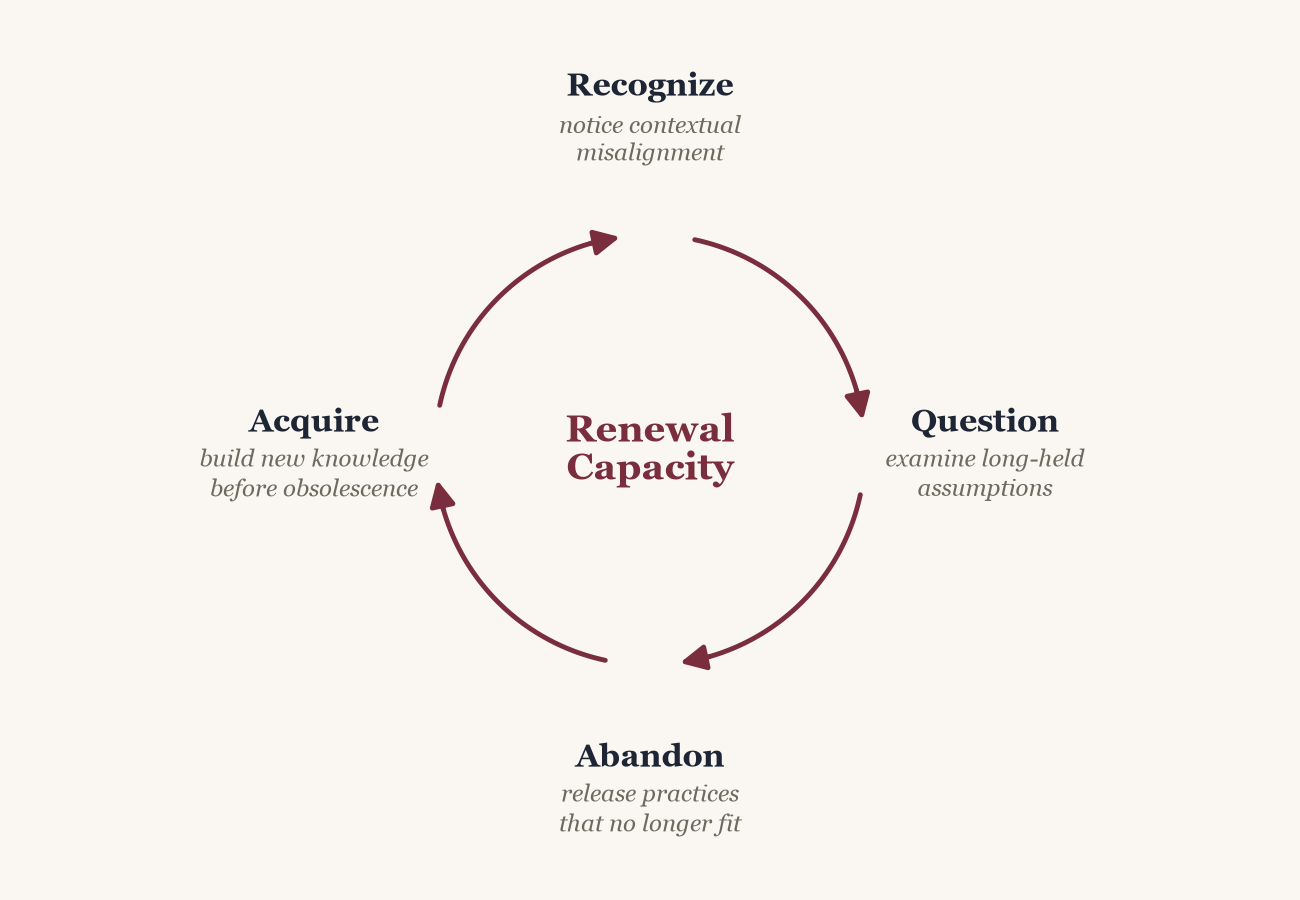
The most resilient professionals are not those who resist change, nor those who chase every emerging trend. They are the ones who repeatedly realign their Knowledge Portfolio with the changing demands of their profession, while preserving the forms of knowledge that compound through experience.
Organizations carry a parallel responsibility. An institution whose collective expertise sits almost entirely in operational knowledge is vulnerable to technological disruption. One that rewards only technical certification while neglecting judgment systematically underinvests in its most durable capability. Professional development should move beyond counting training hours or certificates completed, toward the health, balance, and renewal of the organization's collective Knowledge Portfolio.
The Shadow Side of the Framework
Every conceptual framework simplifies reality. This one is no exception.
The first risk is encouraging breadth at the expense of depth. Recognizing that some knowledge changes quickly should not discourage deep expertise — on the contrary, depth remains essential, because meaningful judgment cannot develop without substantial conceptual and operational foundations.
The second risk is ageism. It is easy to see fast-changing operational knowledge and wrongly conclude that experienced professionals themselves have become obsolete. The framework argues the opposite: while certain knowledge assets depreciate, others — particularly judgment — often appreciate through experience, reflection, and repeated exposure to complexity.
The third risk is entrenchment. Judgment is not immune to change: when a field shifts regime rather than drifting, a veteran’s pattern recognition can mislead as readily as it helps, and the same experience that makes judgment valuable can make it hard to question. Judgment needs renewal too.
The fourth risk is permanent renewal anxiety. Professionals do not need to continually reinvent themselves. Not every innovation deserves immediate adoption; not every trend reshapes an entire profession. Renewal should be intentional rather than reactive. The purpose of the framework is not to accelerate change — it is to help professionals tell what genuinely needs renewal from what deserves continued investment.
Conclusion
Professional relevance is no longer determined simply by how much knowledge an individual accumulates over a career. It increasingly depends on how consciously that individual maintains alignment between their Knowledge Portfolio and the evolving contexts in which that knowledge is expected to create value.
This does not mean experience has become less valuable. It means something more nuanced: different forms of professional knowledge carry different degrees of context dependency, and those differences produce characteristic Half-Life Profiles for professions and distinctive Knowledge Portfolios for individuals. Recognizing those patterns lets professionals move past the vague anxiety of keeping up, toward a more deliberate practice of renewal.
A career is not the accumulation of knowledge. It is the continual rebalancing of a Knowledge Portfolio.
What matters is not how much you know — it is whether what you know still fits the world in which you are asked to use it.
Map Your Knowledge Portfolio
This closing exercise is a thinking tool, not an assessment instrument. There are no correct answers and no score — the value lies in the quality of reflection.
- Where are you most heavily invested? Which knowledge occupies most of your learning time today? How much of it is Type A (Operational), Type B (Conceptual), or Type C (Judgment)?
- Which capabilities are most context-dependent? If your organization adopted a different technology platform, restructured its operations, or significantly changed its regulatory environment, which parts of your expertise would need immediate renewal?
- Which capabilities have appreciated with experience? Which professional judgments do you hold today that neither software, AI, nor a newly qualified colleague could easily replicate? How were those capabilities built?
- How strong is your Renewal Capacity? Think about your habits, not your intentions. When did you deliberately unlearn something? When did you replace a familiar practice because a better one emerged? When did you last study something that challenged your assumptions?
- Where is your portfolio unbalanced? Are you overinvested in operational knowledge? Have you neglected conceptual knowledge? Have you invested enough in judgment? Which part of your portfolio deserves your next learning investment?
These questions are not meant to be answered once. They are meant to become part of an ongoing professional conversation. The objective was never to preserve every piece of knowledge indefinitely — it is to keep the Knowledge Portfolio aligned with the changing context in which professional value is created.
Notes and Sources
The three knowledge types and the Knowledge Portfolio are this essay’s own framework; the curves and shares in the figures are illustrative, not measured. The ideas draw on earlier work:
- Samuel S. Dubin, “Obsolescence or Lifelong Education: A Choice for the Professional,” American Psychologist 27, no. 5 (1972): 486–498.
- Michael Polanyi, The Tacit Dimension (Doubleday, 1966).
- Chris Argyris, “Double Loop Learning in Organizations,” Harvard Business Review, September–October 1977.
- Donald A. Schön, The Reflective Practitioner (Basic Books, 1983).
- Samuel Arbesman, The Half-Life of Facts (Current, 2012).